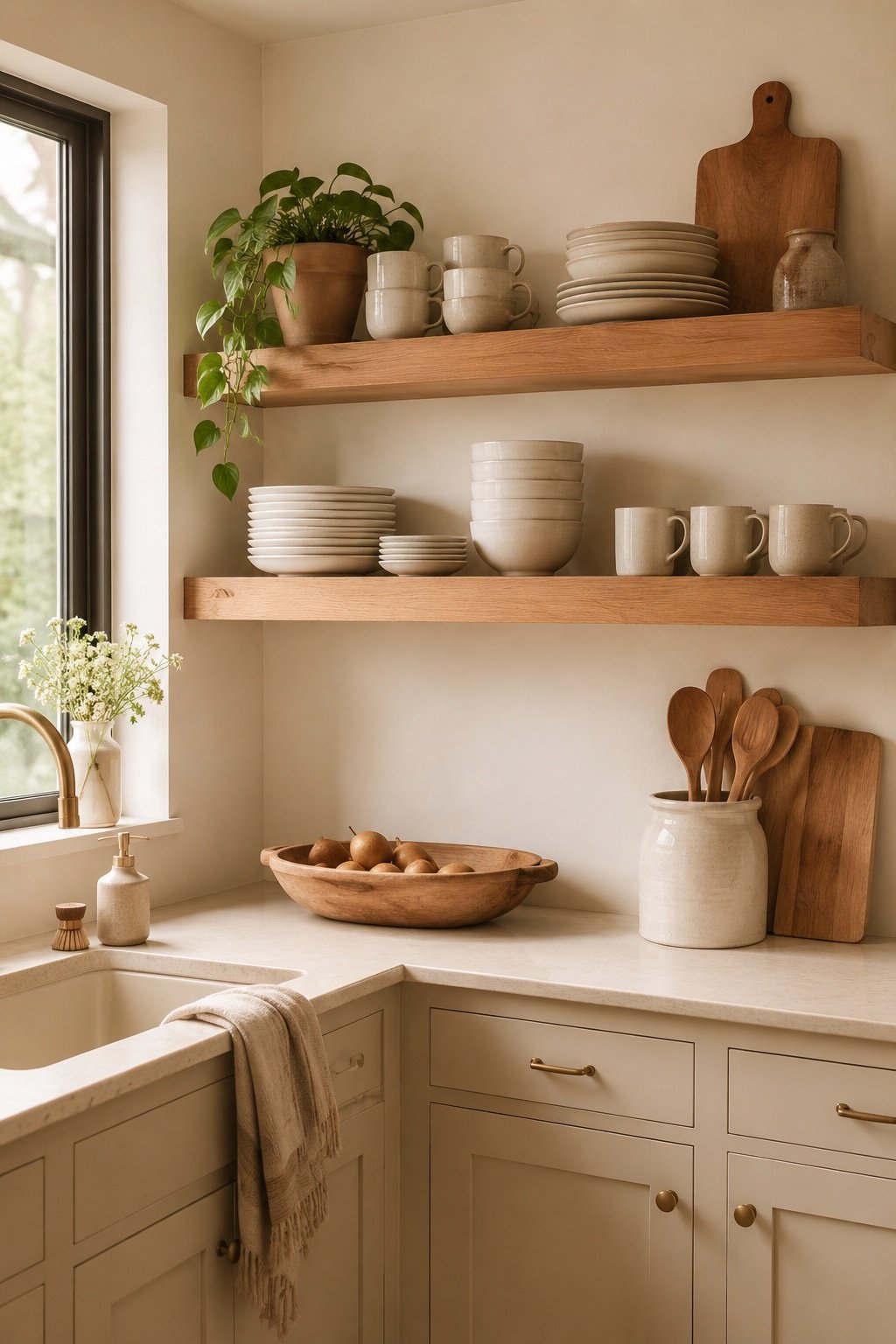
Open shelving is the kitchen trend people either adore or blame for ruining their lives, and both camps are describing the same shelves. The difference is almost never taste. It’s whether the shelves were put where the household’s actual habits could support them. Here’s the honest accounting, and then how to style them if you’re in.
The case for
- The room breathes. Upper cabinets are a solid visual wall at eye level. Take them away and a small kitchen feels noticeably larger, because you can see the wall behind.
- Light travels. Especially with a window on the same wall, open shelves stop the cabinet run from blocking daylight into the corners.
- Everyday things get easier. No door to open. Grab a mug with one hand while the other holds a kid. This is a real daily gain and it’s why restaurant kitchens work this way.
- It’s cheap. Two brackets and a board versus a cabinet run is a difference of thousands of dollars. Open shelving is the highest-impact low-cost kitchen change there is.
- You edit. Having to see your dishes means you stop keeping the ones you hate. Most people find this genuinely good for them.
The case against
- Dust and grease are real. Not a myth. Anything within about eight feet of a stove develops a film that dust sticks to. Dishes you use daily stay clean because they cycle through the dishwasher. Dishes you use twice a year become a chore.
- You lose storage. A shelf holds meaningfully less than a cabinet of the same footprint, because you can’t stack to the ceiling and have it still look right. In a small kitchen with no pantry, this can be disqualifying.
- Everything is on display forever. The mismatched mug from a conference, the plastic kid cups, the box of tea bags. If your dishes are a collection of survivors, the shelves will say so.
- It demands a habit. A cabinet forgives chaos behind a door. A shelf doesn’t. If nobody in the house puts things back in the right spot, open shelving turns your worst habit into your kitchen’s focal point.
The honest test
Before committing, answer these three:
Do you have enough closed storage elsewhere? A pantry, a full run of lower cabinets, a nearby cupboard. If the uppers are your only storage, replacing all of them is a decision you’ll regret by the second week.
Do you cook with a lot of oil, and is the shelf near the range? If yes and yes, that shelf will need wiping monthly. Some people don’t mind. Know which person you are before, not after.
Are your everyday dishes ones you’d want to look at? Not fancy. Just coherent. A stack of plain white plates and some wooden boards is enough. If the answer is no, the shelves aren’t your problem, and buying a set of plain dinnerware is a cheaper fix than a kitchen remodel either way.
The compromise almost everyone should make
You do not have to choose. The version that works in real houses is mixed: keep cabinets on the wall by the stove, where the grease and the bulk storage are, and open shelves on one other wall, ideally near a window or over the coffee area.
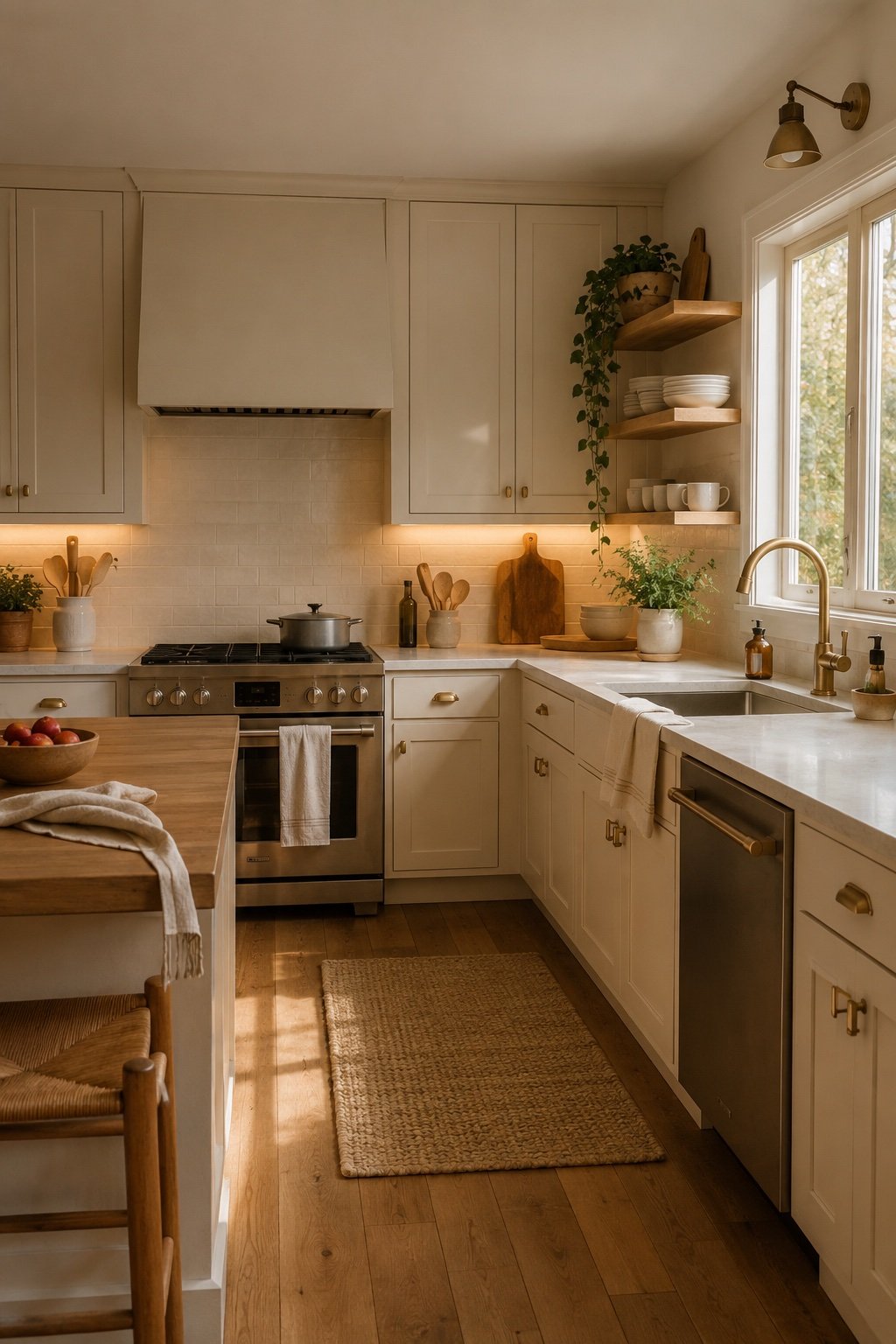
You get the visual opening, the daily-grab convenience, and the display, and you keep somewhere to hide the mixing bowls and the cereal. Nearly every open-shelf kitchen you’ve admired is doing this, and the photo just didn’t show the cabinet wall.
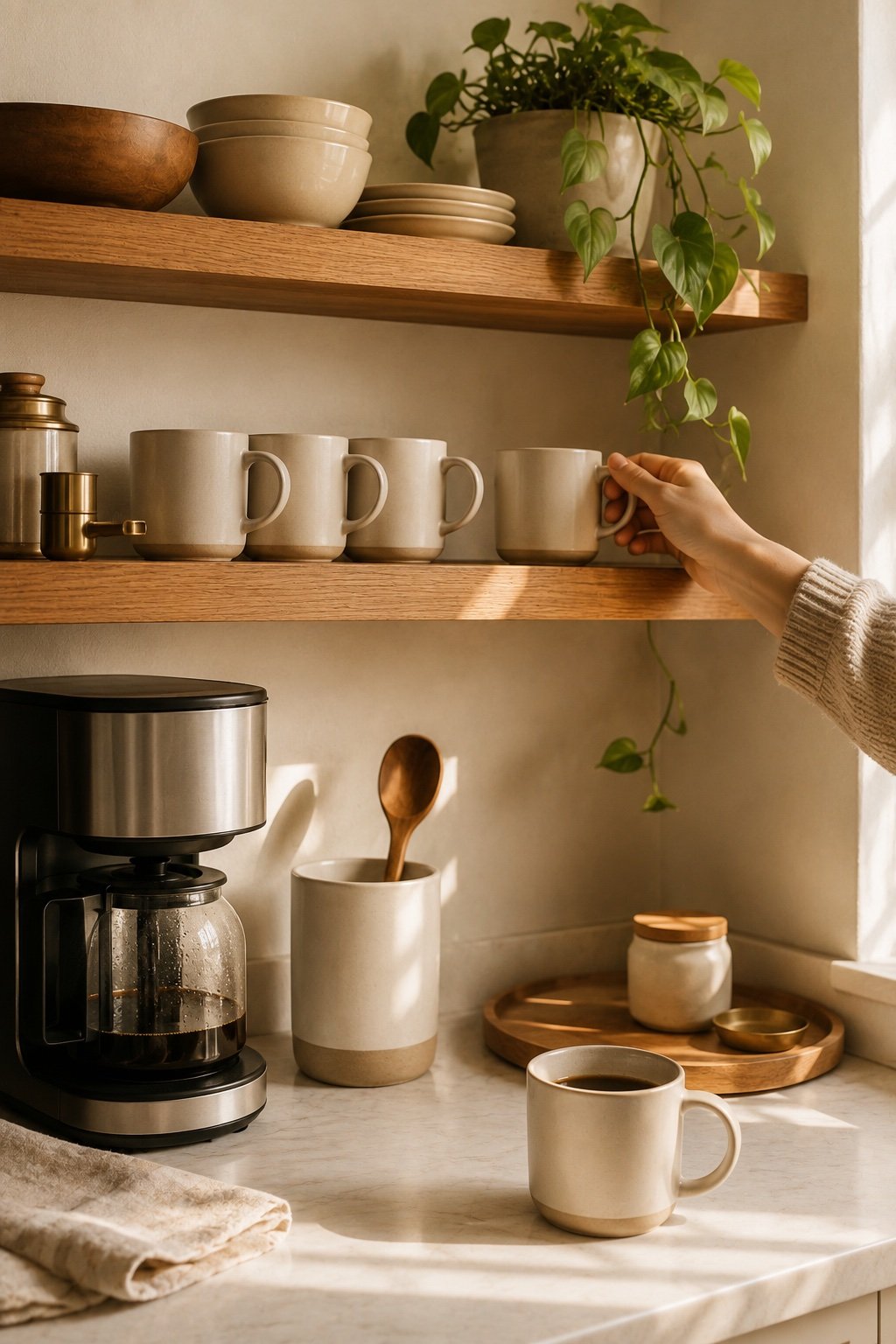
The best single spot: two shelves over the coffee maker or the sink. Mugs and everyday glasses cycle through fast enough that dust never lands, and they’re the things you reach for half asleep.
How to build them right
- Depth: 10 to 12 inches. Deeper and the back row is dead space you’ll fill with things that never move. Shallower and a dinner plate hangs over the edge.
- Thickness: a thin shelf sags and reads flimsy. 1.5 to 2 inches of solid wood looks substantial and holds a stack of stoneware without a bow.
- Spacing: 12 to 14 inches between shelves is right for plates, bowls, and mugs with a hand in there. Under 11 inches and you’re wedging.
- Height: bottom shelf about 18 inches above the counter. Enough to use the counter under it, low enough to reach.
- Into studs, always. Loaded with stoneware, a shelf carries real weight. Drywall anchors are how people end up with a pile of broken plates.
- Two shelves, not four. The number one mistake. Four shelves is a cabinet without doors, and it’s worse than a cabinet at every job.
Styling them so they look like the photos
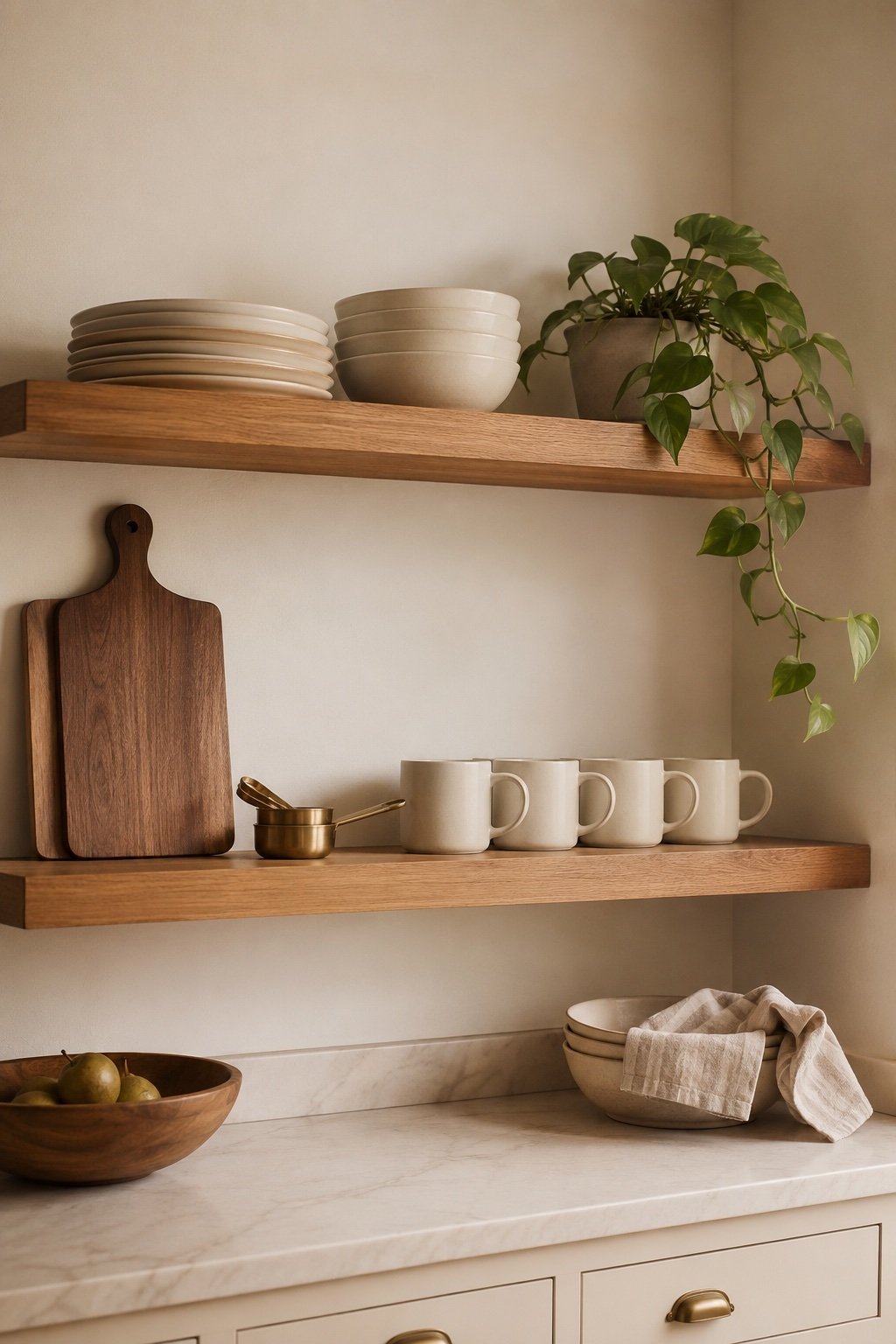
The trick is that the good ones are mostly the same objects repeated, not a curated variety:
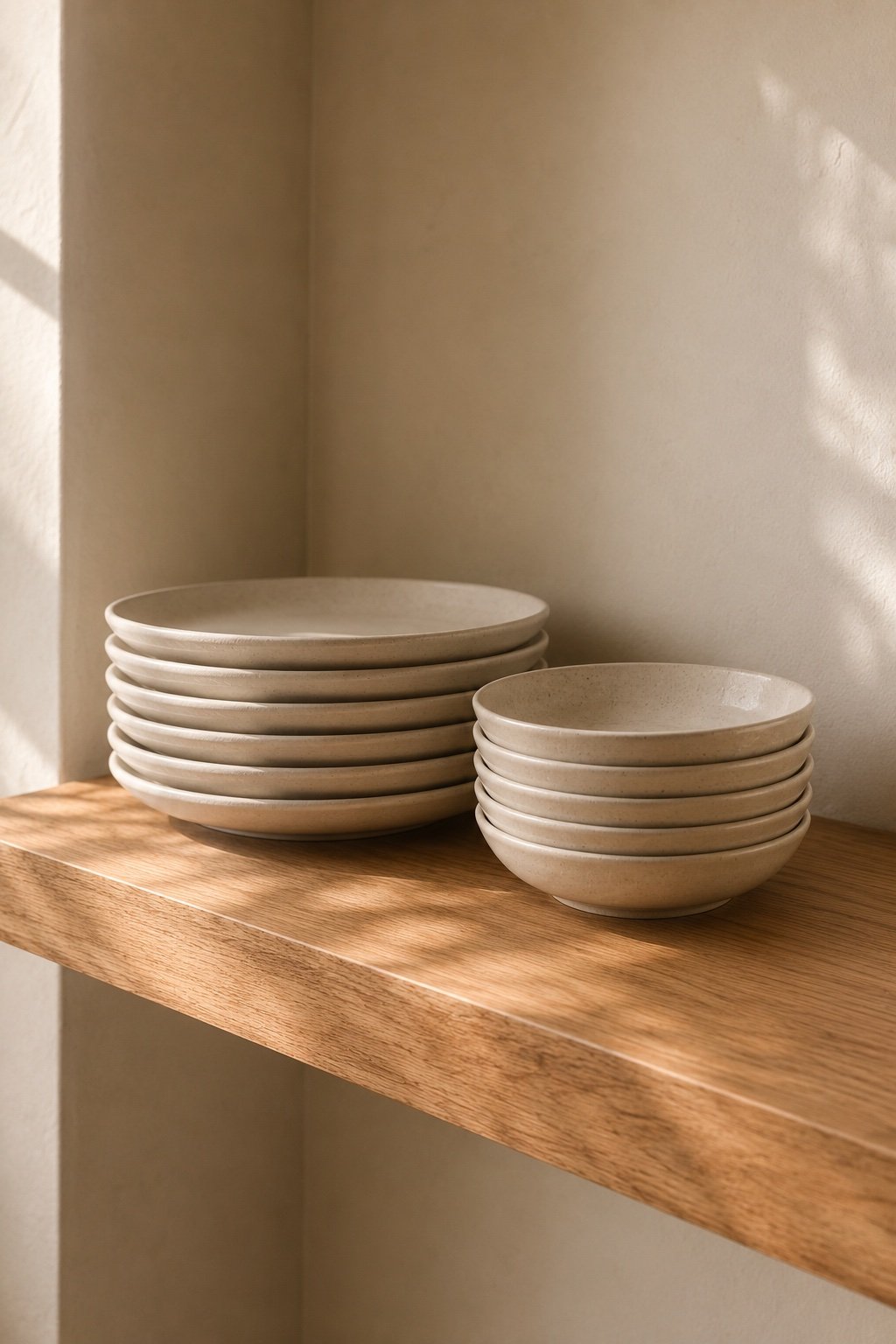
- Stack the same thing. Six identical white plates in one stack looks intentional. Six different plates looks like a cupboard. Repetition is the entire aesthetic.
- Use real things. Everything on the shelf should be something you use. A shelf of props reads like a showroom and, worse, collects dust because it never cycles.
- One material break. A wooden board leaned at the end, a brass measuring set, a small plant. One warm interruption in the run of ceramic.
- Leave the last quarter empty. Same rule as any shelf. Air is what says chosen.
- Hide the ugly. Tea bags, vitamins, the good knives. Those go in the cabinet you kept.
The renter version
If you can’t remove cabinets, you can still get most of the effect. Take the doors off one cabinet, keep them in a closet, and paint the inside back panel a warm tone. Fifteen minutes, fully reversible, and you’ll learn within a month whether you actually like living with open storage. That’s a much cheaper way to find out than a remodel.
The verdict
Open shelving is worth it if you have storage elsewhere, if the shelf isn’t next to the range, and if the things going on it are things you use every day. Under those three conditions it’s one of the best-value changes you can make to a kitchen.
Outside those conditions it’s a trend that quietly turns into a chore. Two shelves in the right spot beats a whole wall in the wrong one, every time.
Keep Reading
📖 Kitchen Counter Styling: What to Keep Out (and What to Hide)
📖 Kitchen Witch Decor: How to Make a Cozy, Witchy Kitchen for Fall
📖 Coffee Bar Ideas That Fit in Two Feet of Counter